Investing in Treasury Bonds: 4.2% Yield Attracts Investors

Advertisements
The analysis Investing in Treasury Bonds in 2026: A Safe Haven with Current Yields Above 4% evaluates the shifting fixed-income landscape under current Federal Reserve monetary policies.
This objective report highlights verified data on yield structures, explains how persistent inflation impacts bond values, and outlines the strategic indicators investors across the United States must monitor to optimize portfolio stability.
Understanding Treasury Bonds as a Safe Haven
Treasury bonds, backed by the full faith and credit of the U.S. government, are traditionally considered one of the safest investment options available.
Their low-risk profile makes them particularly appealing during periods of economic uncertainty or market volatility.
The perception of Treasury bonds as a safe haven stems from the government’s ability to tax and print money, ensuring its capacity to meet debt obligations.
This fundamental security underpins their appeal for conservative investors and those seeking capital preservation.
For investors focused on Treasury Bonds 2026, this safety aspect is paramount, offering a reliable anchor in a diversified portfolio.
The current yields, often above 4%, add a layer of attractiveness not seen in recent years, merging security with competitive returns.
Current Yields and Market Dynamics
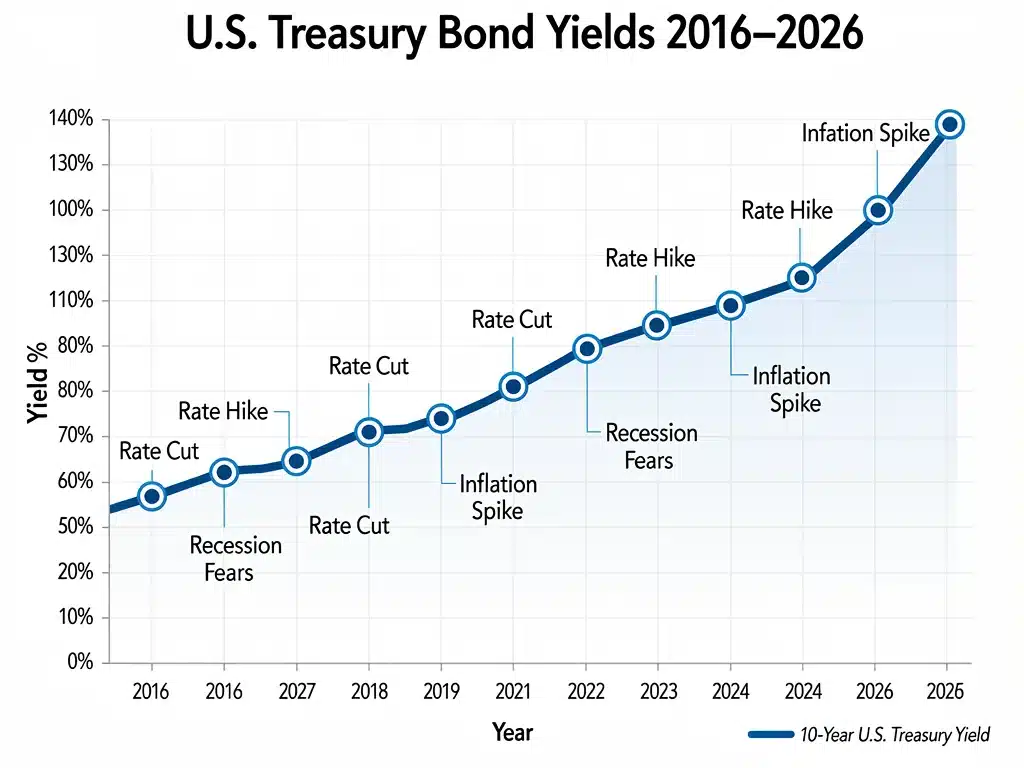
The current landscape for Treasury bond yields is significantly influenced by the Federal Reserve’s monetary policy, particularly its efforts to combat inflation.
Interest rate hikes have directly impacted bond yields, pushing them to levels not observed in over a decade.
Yields on short-to-medium term Treasury bonds, including those maturing in 2026, have responded robustly to these policy adjustments.
This environment presents a unique opportunity for investors to lock in higher returns on relatively short-duration assets.
Market dynamics, including investor demand, global economic outlooks, and inflation expectations, continuously shape these yields.
Monitoring these factors is essential for anyone considering Treasury Bonds 2026 as part of their investment strategy.
Factors Influencing Treasury Yields
Several key factors contribute to the fluctuation and current elevation of Treasury yields. Federal Reserve policy decisions, especially regarding the federal funds rate, are primary drivers.
Inflationary pressures also play a significant role, as investors demand higher yields to compensate for the erosion of purchasing power.
Global economic shifts and geopolitical events can also impact the perceived risk and attractiveness of U.S. government debt.
- Federal Reserve interest rate decisions and forward guidance.
- Inflation data and expectations for future price increases.
- Global economic growth forecasts and geopolitical stability.
Comparing 2026 Bonds to Other Maturities
When considering Treasury Bonds 2026, it is important to compare their yields and characteristics to bonds of different maturities. Shorter-term bonds generally offer less interest rate risk but may have lower yields than longer-term counterparts.
Currently, the yield curve has exhibited inversions at various points, where shorter-term bonds offer higher yields than longer-term ones. This phenomenon reflects market expectations regarding future economic conditions and monetary policy.
For investors, selecting the appropriate maturity depends on their investment horizon, liquidity needs, and interest rate outlook.
Treasury Bonds 2026 strike a balance, offering attractive yields without the extended duration risk of longer-term bonds.
Benefits of Investing in Treasury Bonds 2026
Investing in Treasury Bonds 2026 provides several distinct advantages for a diverse range of investors. The primary benefit remains their unparalleled safety, as they are virtually free of default risk, a critical consideration in volatile markets.
The current yields above 4% offer a compelling income stream, especially when compared to historical lows seen in previous years. This makes them attractive for income-focused investors or those seeking to diversify their portfolio beyond equities.
Furthermore, Treasury bonds can play a crucial role in portfolio diversification, acting as a hedge against equity market downturns. Their low correlation with stocks can help reduce overall portfolio volatility, enhancing stability.
Risk Mitigation and Portfolio Diversification
Treasury bonds are a cornerstone for risk mitigation within an investment portfolio. Their inherent stability provides a counterbalance to more volatile assets like stocks, especially during periods of economic contraction or uncertainty.
By including Treasury Bonds 2026, investors can reduce their exposure to market fluctuations, preserving capital during downturns.
This diversification strategy is widely recommended by financial advisors to achieve a more balanced risk-reward profile.
The specific maturity of 2026 means investors can anticipate a return of their principal within a relatively short timeframe, further managing interest rate risk compared to longer-dated bonds.
Attractive Income Stream and Capital Preservation
The current yields above 4% mean that Treasury Bonds 2026 offer a significant income component to investors. This regular income stream can be particularly valuable for retirees or those relying on fixed income for living expenses.
Beyond income, the primary objective for many Treasury bond investors is capital preservation. Knowing that the principal invested is virtually guaranteed by the U.S. government provides immense peace of mind.
This combination of attractive income and robust capital preservation makes Treasury Bonds 2026 a strong candidate for conservative segments of a portfolio. It ensures both stability and a meaningful return on investment.
Potential Risks and Considerations
While Treasury bonds are considered safe, they are not entirely without risks, primarily related to interest rate fluctuations. Investors must understand how changing interest rates can impact the value of their bond holdings.
If interest rates rise after purchasing a bond, the market value of existing bonds with lower yields may decrease. This is particularly relevant if an investor needs to sell their bonds before maturity.
Inflation risk is another consideration, as high inflation can erode the real return on fixed-income investments, even with yields above 4%. Investors should assess their inflation expectations when considering Treasury Bonds 2026.
Interest Rate Risk Explained
Interest rate risk refers to the possibility that changes in prevailing interest rates will negatively affect the value of a bond. When interest rates rise, newly issued bonds offer higher yields, making older bonds with lower yields less attractive.
For investors holding Treasury Bonds 2026, if rates increase significantly, the market price of their bonds could fall if they decide to sell before maturity. However, if held to maturity, the investor will still receive their full principal back.
This risk is generally lower for shorter-duration bonds, like those maturing in 2026, compared to long-term bonds. The closer to maturity, the less sensitive a bond’s price is to interest rate changes.
Inflationary Pressures and Real Returns
Inflation represents a significant concern for fixed-income investors, as it diminishes the purchasing power of future cash flows. Even with nominal yields above 4%, high inflation can lead to a lower real return on investment.
When considering Treasury Bonds 2026, investors should compare the bond’s yield to current and expected inflation rates. If inflation outpaces the bond’s yield, the real return could be negative.
However, Treasury Inflation-Protected Securities (TIPS) offer a mechanism to directly counter inflation risk by adjusting their principal value.
While traditional Treasury bonds don’t offer this, their current yields provide a buffer against moderate inflation.
How to Invest in Treasury Bonds 2026
Investing in Treasury Bonds 2026 is accessible through several avenues, catering to different investor preferences and needs. The most direct method is purchasing them through TreasuryDirect, a platform operated by the U.S. Department of the Treasury.
Alternatively, investors can buy Treasury bonds through brokerage firms, which often offer more comprehensive investment services and portfolio management tools.
These firms can facilitate purchases of both newly issued and existing bonds in the secondary market.
For those seeking diversified exposure, mutual funds and exchange-traded funds (ETFs) that specialize in government bonds are also viable options.
These funds offer convenience and professional management, though they come with management fees.
Purchasing Through TreasuryDirect
TreasuryDirect allows individual investors to purchase U.S. Treasury securities directly from the government without fees or commissions. This platform offers a straightforward way to buy new issues of bills, notes, and bonds.
To acquire Treasury Bonds 2026 through TreasuryDirect, investors can set up an account, link it to their bank account, and participate in Treasury auctions. This method ensures direct ownership and avoids intermediary costs.
It is an ideal option for investors who prefer a hands-on approach and wish to hold their bonds to maturity. The website provides clear instructions and resources to guide investors through the process.
Brokerage Accounts and Funds
For investors who prefer convenience or require broader investment services, purchasing Treasury Bonds 2026 through a brokerage account is a popular choice. Brokerage firms offer access to both primary and secondary markets.
This means investors can buy newly issued bonds or purchase existing bonds that are already trading. Brokerage accounts often provide research tools, financial advice, and the ability to manage a diverse portfolio of assets.
Additionally, bond mutual funds and ETFs offer a way to invest in a basket of Treasury bonds, providing diversification across maturities and potentially lower minimum investment amounts.
These funds are professionally managed, but investors should be aware of associated fees.
Expert Outlook and Future Projections
Financial analysts and economic experts closely monitor the factors influencing Treasury bond yields, offering projections that can guide investor decisions.
The consensus generally points to continued volatility in interest rates, albeit within a more defined range.
Many experts believe that while the Federal Reserve may eventually ease its aggressive stance on rate hikes, yields on short-to-medium term bonds like Treasury Bonds 2026 could remain elevated for some time.
This is due to persistent inflation and the need to keep real rates positive.
Geopolitical tensions and global economic growth trajectories will also play a crucial role in shaping the future of Treasury yields. Investors are advised to stay informed on these broader economic and political developments.

Analyst Consensus on Yield Trajectory
The general analyst consensus suggests that while the peak in interest rates might be approaching, a sharp decline in yields for Treasury Bonds 2026 is not immediately expected.
Economic data, particularly inflation and employment figures, will heavily influence the Fed’s next moves.
Many foresee a ‘higher for longer’ scenario for interest rates, meaning yields could remain attractive for the foreseeable future. This outlook supports the continued appeal of Treasury bonds for income-seeking investors.
However, there is always a divergence of opinions, with some analysts predicting a more rapid decline in yields if economic growth slows considerably. Staying updated with various expert perspectives is vital for a balanced view.
Impact of Economic Data and Fed Policy
Economic data releases, such as consumer price index (CPI) reports, employment statistics, and GDP figures, significantly influence market expectations for Federal Reserve policy.
Strong economic data might lead the Fed to maintain higher rates for longer, impacting Treasury Bonds 2026 yields.
Conversely, signs of an economic slowdown or significant disinflation could prompt the Fed to consider rate cuts, which would typically cause bond yields to fall.
The Fed’s communication and forward guidance are therefore closely scrutinized by bond investors.
Understanding the interplay between economic indicators and monetary policy is critical for anticipating movements in Treasury bond yields.
This knowledge empowers investors to make timely decisions regarding their fixed-income allocations.
Tax Implications of Treasury Bonds
When investing in Treasury Bonds 2026, understanding the tax implications is crucial for maximizing after-tax returns. A significant advantage of U.S. Treasury securities is that the interest earned is exempt from state and local income taxes.
However, interest income from Treasury bonds is subject to federal income tax. This federal taxation applies regardless of whether the bonds are held directly or through a mutual fund or ETF.
Investors should consult with a tax professional to understand how Treasury bond income fits into their overall tax strategy. This personalized advice can help optimize returns and ensure compliance with tax regulations.
Federal vs. State/Local Taxation
The tax treatment of interest income from Treasury Bonds 2026 is a key benefit for investors, particularly those residing in states with high income taxes. The exemption from state and local taxes can significantly enhance net returns.
This makes Treasury bonds more attractive compared to corporate bonds or municipal bonds from other states, which typically do not offer this specific tax advantage. The federal tax liability, however, remains a constant consideration.
Investors should factor in their marginal federal income tax rate when calculating the effective yield of their Treasury bond investments. This comprehensive view ensures a realistic assessment of their investment’s profitability.
Reporting Requirements and Tax Planning
Income from Treasury Bonds 2026 must be reported on federal income tax returns. For bonds held through TreasuryDirect, investors receive a Form 1099-INT detailing their annual interest income for proper reporting.
For bonds held through brokerage accounts or bond funds, the brokerage firm or fund provider issues the necessary tax documents. Accurate reporting is essential to avoid penalties and ensure compliance.
Strategic tax planning, such as holding Treasury bonds in tax-advantaged accounts like IRAs or 401(k)s, can further optimize returns. While interest is still taxable upon withdrawal from these accounts, it allows for tax-deferred growth.
Long-Term Investment Strategy with Treasury Bonds
Incorporating Treasury Bonds 2026 into a long-term investment strategy can provide stability, income, and diversification. Their role extends beyond short-term market fluctuations, contributing to the overall resilience of a portfolio.
For long-term investors, Treasury bonds can serve as a foundational asset, offering a predictable return component that balances out more aggressive growth investments. This strategic allocation helps manage risk over extended periods.
Rebalancing a portfolio periodically to maintain the desired allocation to Treasury bonds is crucial. This ensures that the portfolio continues to align with the investor’s risk tolerance and financial goals, adapting to changing market conditions.
Balancing Risk and Return
A well-constructed long-term investment strategy involves a careful balance between risk and return. Treasury Bonds 2026 contribute to this balance by offering a low-risk component with attractive yields.
They can act as a ballast during periods when equity markets are under pressure, reducing overall portfolio drawdowns. This stability allows investors to ride out market volatility without panicking or making emotional decisions.
By blending Treasury bonds with growth-oriented assets, investors can aim for consistent returns while managing downside risk effectively. This approach is fundamental to achieving long-term financial objectives.
Future Reinvestment Opportunities
As Treasury Bonds 2026 mature, investors will face reinvestment decisions. The economic environment at that time will dictate the available yields and the attractiveness of future fixed-income opportunities.
The ability to reinvest principal at prevailing market rates is a key aspect of managing a bond ladder or simply taking advantage of future interest rate cycles. This flexibility allows for adaptation to evolving market conditions.
Monitoring economic forecasts and Federal Reserve policy as 2026 approaches will be crucial for making informed reinvestment choices. This forward-looking perspective ensures continued optimization of the fixed-income portion of a portfolio.
| Key Point | Brief Description |
|---|---|
| Safety and Yields | Treasury Bonds 2026 offer high safety with current yields above 4%. |
| Market Dynamics | Fed policy and inflation heavily influence current attractive yields. |
| Tax Advantages | Interest is exempt from state and local taxes, only subject to federal. |
| Investment Access | Available via TreasuryDirect, brokerage firms, or bond funds. |
Frequently Asked Questions About Treasury Bonds 2026
Treasury Bonds 2026 are backed by the full faith and credit of the U.S. government, making them virtually free of default risk. This government guarantee ensures that investors will receive their principal and interest payments as scheduled, offering unparalleled security in the financial market.
The Federal Reserve’s aggressive monetary policy to combat inflation, including multiple interest rate hikes, is the primary driver. Higher benchmark rates push up yields across the board, making short-to-medium term Treasury Bonds 2026 particularly attractive to investors seeking competitive returns.
Yes, interest earned on Treasury Bonds 2026 is exempt from state and local income taxes, though it remains subject to federal income tax. This tax advantage can be particularly beneficial for investors in high-tax states, significantly enhancing their net investment returns.
The primary risks are interest rate risk and inflation risk. If interest rates rise after purchase, the market value of existing bonds may fall if sold before maturity. High inflation can also erode the real return, even with attractive nominal yields.
Individual investors can purchase Treasury Bonds 2026 directly through TreasuryDirect, the U.S. Treasury’s online platform, without fees. Alternatively, they can buy them via brokerage firms or gain diversified exposure through bond mutual funds and ETFs specializing in government securities.
What This Means
The current environment for Treasury Bonds 2026 signals a compelling opportunity for investors seeking a blend of safety and attractive income.
The elevated yields, driven by ongoing monetary policy and inflation concerns, position these bonds as a pivotal component for portfolio stability.
As economic conditions continue to evolve, monitoring Federal Reserve actions and global economic data will be crucial for understanding future yield trajectories.
This strategic focus ensures investors can adapt their holdings to maximize both security and return.
To evaluate how fixed-income assets align with your broader retirement objectives and to explore specialized wealth management strategies, you can download capital insights through the Fisher Investments optimization guides.
The enduring appeal of Treasury bonds, especially those offering yields above 4%, underscores their role as a fundamental asset in a well-diversified investment strategy, providing a reliable anchor in potentially turbulent markets.