Mastering Micro-Credential Stacking for an Accredited Master's Degree
Advertisements

In 2026, the traditional education model is being complemented by a more agile, skills-focused system.
As the US labor market moves toward "skills-based hiring," micro-credentials have emerged as the primary currency for professionals seeking to bridge the gap between their current capabilities and the demands of a rapidly evolving economy.
Data from early 2026 indicates that nearly 90% of employers now offer higher starting salaries to candidates holding relevant digital badges, recognizing these credentials as verifiable proof of competency in specialized areas like AI integration, sustainable project management, and digital literacy.
The Rise of Micro-Credentials in Higher Education
Micro-credentials are fundamentally reshaping how education is delivered and consumed, offering a nimble alternative to traditional, longer degree programs. They provide focused learning experiences that address specific skill gaps, making them highly attractive in today's rapidly evolving job market.
These smaller, verifiable units of learning are designed for immediate applicability, allowing individuals to upskill or reskill without committing to extensive, multi-year programs. This flexibility is critical for working professionals seeking to advance their careers while balancing existing responsibilities.
Universities are increasingly integrating micro-credentials into their offerings, recognizing their potential to serve a broader student demographic and to provide more agile responses to industry demands. This integration is key to understanding how micro-credential stacking master's degrees are becoming a viable option.
Defining Micro-Credentials and Their Value
Micro-credentials are typically shorter than traditional courses, often taking weeks or months to complete, and result in a digital badge or certificate. They validate mastery of a specific skill or competency, ranging from data analytics to project management or digital marketing.
Their value lies in their direct relevance to workforce needs and their ability to provide tangible evidence of skill acquisition. For individuals, they offer a clear path to demonstrating proficiency, enhancing employability, and staying competitive in dynamic industries.
Focused skill acquisition for immediate career impact.
Flexibility in learning schedule and pace.
Verifiable proof of competency through digital badges.
The Concept of Stacking Credentials
Credential stacking involves accumulating multiple micro-credentials that, when combined, can be recognized as equivalent to a larger qualification, such as a graduate certificate or even a master's degree. This modular approach allows learners to build their educational profile incrementally.
This strategy offers significant advantages, including reduced upfront commitment, the ability to test out different areas of study, and the flexibility to pause and resume education as life or career demands dictate. It democratizes access to higher education by breaking down traditional barriers.
The shift towards micro-credential stacking master's programs reflects a broader trend of personalized and flexible learning, moving away from a one-size-fits-all model. It allows individuals to curate their educational journey based on their unique professional goals.
Identifying Accredited Programs for Micro-Credential Stacking
For micro-credential stacking to lead to a recognized Master's Degree, accreditation is paramount. Not all micro-credentials are created equal, and their acceptance towards a degree depends heavily on the issuing institution's and the program's accreditation status.
Prospective students must diligently research institutions offering these pathways, ensuring that the micro-credentials are from accredited providers and that the stacking pathway itself is formally recognized by the university. This due diligence protects the investment of time and resources.
Understanding the difference between institutional accreditation and program-specific accreditation is crucial. Both play a role in the legitimacy and transferability of credits when pursuing a micro-credential stacking master's degree.
Accreditation Bodies and Standards
In the United States, regional and national accrediting agencies oversee the quality of higher education institutions and programs. Regional accreditation is generally considered the gold standard for transferability of credits and recognition of degrees.
When evaluating micro-credential programs, check if the issuing institution is regionally accredited. Additionally, some specialized fields have programmatic accreditation bodies that ensure specific standards are met, which can be vital for professional licensure or industry recognition.
Regional accreditation ensures broad acceptance of credits.
Programmatic accreditation validates specific field competencies.
Verify accreditation status through official accrediting agency websites.
Finding Universities that Support Stacking
A growing number of forward-thinking universities are actively developing and promoting pathways for micro-credential stacking towards master's degrees. These institutions often design their certificate programs with the explicit intention of allowing them to be combined.
Identifying these universities requires careful investigation of their graduate admissions policies and program descriptions. Many institutions will clearly outline how specific certificate courses can articulate into a master's program, sometimes even offering preferred admission for certificate completers.
Look for programs explicitly mentioning "stackable credentials," "pathways to a master's," or "credit for prior learning" policies. Direct communication with admissions counselors or program directors is also highly recommended to confirm specific details regarding micro-credential stacking master's options.
Strategic Selection of Certificate Courses
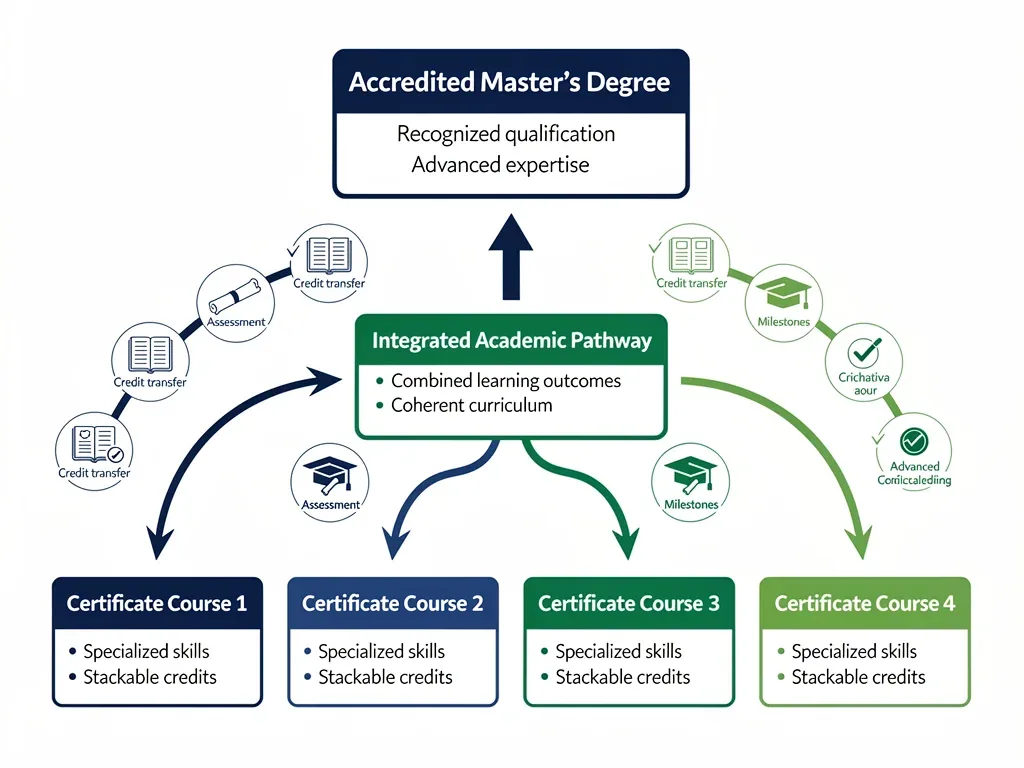
The success of Navigating Micro-Credential Stacking: How to Turn 4 Certificate Courses into an Accredited Master's Degree hinges on the strategic selection of the initial certificate courses.
These courses should not only align with immediate skill needs but also form a coherent foundation for the desired master's program.
Careful planning involves identifying a master's degree program first, then working backward to select micro-credentials that directly contribute to its curriculum requirements. This ensures that each certificate earned serves a dual purpose: immediate skill enhancement and long-term academic progression.
Ignoring this strategic alignment can lead to wasted effort and non-transferable credits, undermining the entire stacking objective. Therefore, understanding the master's degree's core competencies and prerequisites is a critical first step.
Aligning Certificates with Master's Degree Goals
Before enrolling in any micro-credential, thoroughly review the curriculum of your target master's degree. Look for areas where certificate courses can fulfill elective requirements, foundational knowledge, or even core course equivalencies.
Many universities will have specific guidelines on which certificates are eligible for transfer or recognition towards a master's. Some may even offer specific graduate certificate programs that are designed to feed directly into a master's degree.
Map certificate learning outcomes to master's degree requirements.
Prioritize certificates from the same institution offering the master's.
Consult with academic advisors on approved stacking pathways.
Choosing the Right Four Certificates
The choice of four specific certificate courses should be guided by a clear understanding of both your career aspirations and the master's degree's structure. For instance, if pursuing an MBA, certificates in project management, data analytics, leadership, and digital marketing could form a robust foundation.
Consider certificates that offer a blend of theoretical knowledge and practical application, providing a well-rounded skill set. The goal is to build a portfolio of competencies that not only makes you a strong master's candidate but also enhances your professional profile immediately.
The sequence of certificates can also be important; some foundational certificates might be prerequisites for more advanced ones.
A well-thought-out sequence ensures a smooth learning progression and maximizes the impact of each credential in your journey of Navigating Micro-Credential Stacking: How to Turn 4 Certificate Courses into an Accredited Master's Degree.
The Application and Transfer Process
Once the four certificate courses are successfully completed, the next critical phase involves the formal application and credit transfer process to the master's degree program. This step requires meticulous attention to detail and adherence to university policies.
Each institution will have its own set of rules regarding how many micro-credential credits can be transferred, which courses are eligible, and the minimum grade requirements. It is essential to understand these policies well in advance to avoid any surprises.
Proactive engagement with the graduate admissions office and academic advisors is highly recommended throughout this stage. They can provide personalized guidance and clarify any ambiguities in the transfer process for your chosen micro-credential stacking master's program.
Understanding Credit Transfer Policies
Universities typically have limits on the number of transfer credits accepted towards a master's degree, often ranging from 6 to 12 credits. Since many graduate certificates are between 9 and 15 credits, this means not all certificate credits may count.
It is crucial to inquire whether the entire certificate, or just specific courses within it, can be transferred. Some institutions may require a minimum GPA in the certificate courses for them to be eligible for transfer, reinforcing the need for strong academic performance.
Verify maximum transfer credit allowance for the master's program.
Confirm specific course equivalencies and grade requirements.
Understand the timeline for submitting transfer credit requests.
Navigating the Master's Application
The application process for a master's degree after completing micro-credentials is largely similar to traditional applications, but with a few key differences. Applicants should highlight their completed micro-credentials and articulate how these have prepared them for advanced study.
The personal statement or statement of purpose should clearly connect the skills and knowledge gained from the certificate courses to the objectives of the master's program. Emphasize the intentionality behind your micro-credential stacking master's strategy.
Ensure all official transcripts from the institutions where the certificates were earned are submitted. In some cases, letters of recommendation from certificate instructors or program directors can strengthen your application, showcasing your dedication and academic potential.
Benefits and Challenges of Stacking Micro-Credentials
The pathway of Navigating Micro-Credential Stacking: How to Turn 4 Certificate Courses into an Accredited Master's Degree offers a compelling blend of benefits, including enhanced flexibility and immediate career relevance.
However, it also presents unique challenges that prospective learners must consider and prepare for.
On the one hand, this approach democratizes access to higher education, making advanced degrees more attainable for working professionals and those seeking career transitions. It allows for a gradual investment in education, reducing financial and time commitments upfront.
On the other hand, the complexity of navigating diverse institutional policies, ensuring accreditation, and meticulously planning the sequence of credentials can be daunting. A clear understanding of both the advantages and hurdles is essential for a successful journey.
Advantages of a Modular Education Path
One of the primary benefits is the ability to gain marketable skills quickly, applying new knowledge to your career even before completing the full master's degree. This immediate return on investment is a significant draw for many adult learners.
Furthermore, the modular nature allows for greater personalization of the learning journey. Individuals can tailor their educational path to their specific career goals, selecting certificates that fill precise skill gaps or explore emerging areas of interest.
Immediate skill acquisition and career applicability.
Reduced financial and time commitment compared to traditional degrees.
Customizable learning paths aligned with personal and professional goals.
Potential Obstacles and How to Overcome Them
A significant challenge lies in the varying transfer credit policies across institutions. Not all universities readily accept micro-credentials or graduate certificates from other institutions, necessitating thorough research and communication.

Another hurdle can be the lack of a standardized framework for micro-credentials, making it difficult to assess their quality and equivalence. Learners must ensure they are pursuing credentials from reputable, accredited sources to guarantee their value.
Overcoming these obstacles requires proactive planning, extensive communication with university admissions and department heads, and a commitment to understanding the nuances of accreditation and transferability.
Persistence and clear documentation of learning outcomes are key to successfully Navigating Micro-Credential Stacking: How to Turn 4 Certificate Courses into an Accredited Master's Degree.
Future Outlook for Micro-Credential Stacking
The trajectory for Navigating Micro-Credential Stacking: How to Turn 4 Certificate Courses into an Accredited Master's Degree appears to be one of continued growth and refinement. As the labor market demands more agile and specialized skill sets, the appeal of modular learning pathways will only intensify.
Educational institutions are responding to this demand by innovating their offerings, creating more clearly defined and streamlined pathways from micro-credentials to full degrees. This evolution will likely make the process more transparent and accessible for future learners.
Industry recognition of micro-credentials is also on the rise, further validating their importance in professional development. This growing acceptance will empower more individuals to leverage these smaller qualifications for significant academic and career advancement.
Emerging Trends in Stackable Credentials
We are seeing a trend towards greater standardization of micro-credentials, with efforts to create common frameworks and interoperable digital badges. This will simplify the process of evaluating and transferring credits, making stacking more seamless.
Universities are also exploring partnerships with industry leaders to co-create micro-credentials that are directly aligned with specific job roles and skill demands. This collaboration ensures the relevance and employability of graduates pursuing a micro-credential stacking master's degree.
Increased standardization and interoperability of micro-credentials.
Stronger university-industry partnerships for relevant curriculum.
Expansion of stackable options across various disciplines.
Impact on Traditional Master's Programs
The rise of micro-credential stacking is prompting traditional master's programs to adapt. Some are incorporating micro-credentials as entry points or offering them as specialized concentrations within existing degrees, providing greater flexibility to students.
This shift encourages a more learner-centric approach, where individuals have more control over their educational journey and can tailor it to their specific needs. It signals a move away from rigid degree structures towards more dynamic and responsive models.
Ultimately, the integration of micro-credentials into master's pathways is not about replacing traditional degrees but rather enhancing them, offering diverse entry points and flexible progression options.
This evolution benefits both students and the institutions committed to lifelong learning in the digital age, especially for those interested in micro-credential stacking master's.
Key Point | Brief Description |
|---|---|
Strategic Selection | Choose certificates aligning with master's goals and career aspirations. |
Accreditation Crucial | Ensure both institutions and programs are accredited for credit transfer. |
Transfer Process | Understand university policies on transfer credits and application requirements. |
Future Trends | Expect increased standardization and industry-academic collaboration. |
Frequently Asked Questions About Micro-Credential Stacking
What exactly is micro-credential stacking?▼
Micro-credential stacking involves earning several smaller, focused qualifications that, when combined, can be recognized by an educational institution as fulfilling requirements towards a larger degree, like a master's. It offers a flexible, modular pathway to advanced education and specialized skills.
Are all micro-credentials stackable?▼
No, not all micro-credentials are designed to be stackable towards a master's degree. It is crucial to research programs specifically advertised as offering stackable pathways or those issued by universities that clearly articulate credit transfer policies for their graduate certificates.
How many certificate courses typically equate to a master's degree?▼
While the article focuses on four, the exact number varies by institution and program. Often, two to three graduate-level certificates (each typically 9-15 credits) can transfer enough credits to significantly reduce the remaining coursework for a master's degree.
What are the main benefits of this approach?▼
The primary benefits include increased flexibility, the ability to gain job-relevant skills quickly, and a lower initial financial and time commitment. It allows professionals to incrementally build their qualifications while remaining active in the workforce.
What should I look for in an institution when stacking micro-credentials?▼
Look for regionally accredited institutions with clearly defined transfer credit policies for graduate certificates. Prioritize universities that explicitly offer stackable pathways or have a strong track record of recognizing prior graduate-level learning to facilitate your micro-credential stacking master's journey.
Looking Ahead: The Enduring Impact of Micro-credentials
The trajectory of The Rise of Micro-credentials: Boosting Your Career Prospects in the US by 2027 points towards a fundamental restructuring of education and workforce development.
In conclusion, these agile credentials are not merely a passing trend but a strategic response to the dynamic demands of the 21st-century economy.
Their continued evolution will empower individuals with relevant skills, foster economic resilience, and redefine pathways to professional success for years to come.
Policymakers, educators, and employers must collaborate to ensure equitable access and robust integration into the national talent strategy.
For educators and professionals seeking to lead this transition through proven, competency-based learning, you can explore the extensive library of NEA micro-credentials for professional excellence.