New Homebuyer Assistance Programs 2026: Accessing Up to $10,000 Grants

Advertisements
Latest developments on New Homebuyer Assistance Programs 2026: Accessing Up to $10,000 in Down Payment Grants, with key facts, verified sources and what readers need to monitor next in Estados Unidos, presented clearly in Inglês (Estados Unidos) (en-US).
New Homebuyer Assistance Programs 2026: Accessing Up to $10,000 in Down Payment Grants is shaping today’s agenda with new details released by officials and industry sources. This update prioritizes what changed, why it matters and what to watch next, in a straightforward news format.
As the housing market continues to evolve, potential homeowners are eagerly anticipating the opportunities that New Homebuyer Assistance Programs 2026: Accessing Up to $10,000 in Down Payment Grants will offer. These initiatives are designed to make homeownership more attainable, especially for first-time buyers and those in underserved communities.
Understanding the intricacies of these programs, from eligibility criteria to application processes, is paramount for anyone looking to secure a foothold in the real estate market. This article delves into the specifics, providing a comprehensive overview of what to expect and how to prepare.
The financial support, potentially reaching up to $10,000 in down payment grants, represents a significant boost for many households. This aid can substantially reduce the upfront costs associated with purchasing a home, making a long-held dream a tangible reality for countless Americans.
Overview of New Homebuyer Assistance Programs 2026
Authorities have confirmed new timelines and outlined initial impacts across different regions regarding the New Homebuyer Assistance Programs 2026: Accessing Up to $10,000 in Down Payment Grants. Statements from representatives indicate short-term adjustments and a more defined path for upcoming decisions, signaling a proactive approach to housing affordability.
These programs are not merely a continuation of past initiatives; they incorporate lessons learned and address current market challenges, aiming for greater efficacy and broader reach. The focus is on sustainable homeownership, ensuring beneficiaries are well-equipped for the responsibilities that come with it.
The overarching goal is to stimulate the housing market while simultaneously empowering individuals and families to achieve financial stability through homeownership. This dual objective underpins the design and implementation of the upcoming assistance programs.
Key Features of the 2026 Programs
The 2026 programs are expected to feature enhanced flexibility and increased funding allocations compared to previous years. This includes broader eligibility criteria to encompass a wider range of income brackets and household compositions, reflecting the diverse needs of potential homebuyers.
Furthermore, there is a strong emphasis on integrating financial literacy and homebuyer education components. These resources aim to equip applicants with the knowledge necessary to navigate the home-buying process confidently and manage their finances effectively post-purchase.
- Expanded eligibility for various income levels.
- Increased funding for down payment and closing cost assistance.
- Mandatory homebuyer education courses for grant recipients.
- Focus on sustainable homeownership and long-term financial health.
Recent data helps clarify the scope and sequence of events, highlighting the strategic rollout of these programs. Markets and local communities have reacted as information became public, with agencies coordinating responses under established protocols to ensure a smooth transition and effective implementation.
Eligibility Criteria and Application Process
Understanding who qualifies for the New Homebuyer Assistance Programs 2026: Accessing Up to $10,000 in Down Payment Grants is the first critical step for aspiring homeowners. While specific details are still being finalized, general guidelines suggest a focus on first-time homebuyers, low-to-moderate income individuals, and those purchasing homes in designated revitalization areas.
The application process is anticipated to be streamlined, leveraging technology to reduce bureaucratic hurdles and improve accessibility. Prospective applicants should prepare essential documentation, including income verification, credit reports, and proof of residency, to expedite their submissions.
Early indications suggest that pre-qualification will play a significant role, allowing individuals to ascertain their potential eligibility before committing extensive time and resources to the full application. This step is designed to provide clarity and manage expectations for all interested parties.
Who Qualifies for Down Payment Grants
Typically, eligibility for down payment grants hinges on several factors, including household income relative to the area median income (AMI), creditworthiness, and the completion of a certified homebuyer education course. These requirements ensure that the assistance reaches those who need it most and are prepared for homeownership.
Some programs may also prioritize specific demographics, such as veterans, educators, or healthcare workers, recognizing their vital contributions to the community. Residency requirements for a certain period in a particular state or county might also be a prerequisite for some localized programs.
- Income limits based on Area Median Income (AMI).
- First-time homebuyer status (generally, not owned a home in the last 3 years).
- Minimum credit score requirements.
- Completion of an approved homebuyer education course.
The topic’s background connects the update to previous milestones, providing a solid foundation for the new programs. Analysts highlight short-term signals that deserve attention before broader trends become clear, emphasizing the importance of staying informed about program updates.
The Impact of $10,000 Down Payment Grants
The potential to access up to $10,000 in down payment grants through the New Homebuyer Assistance Programs 2026: Accessing Up to $10,000 in Down Payment Grants represents a transformative opportunity for many aspiring homeowners. This significant financial injection can bridge the gap between saving for a down payment and actually securing a home.
For many, the down payment is the single largest barrier to homeownership, and this level of assistance can substantially alleviate that burden. It not only reduces the initial out-of-pocket expense but can also free up personal savings for other crucial moving or furnishing costs.
Beyond the immediate financial relief, these grants foster greater equity and stability in communities by increasing homeownership rates. This has ripple effects, contributing to local economic growth and strengthening community ties.
Financial Relief and Market Stimulation
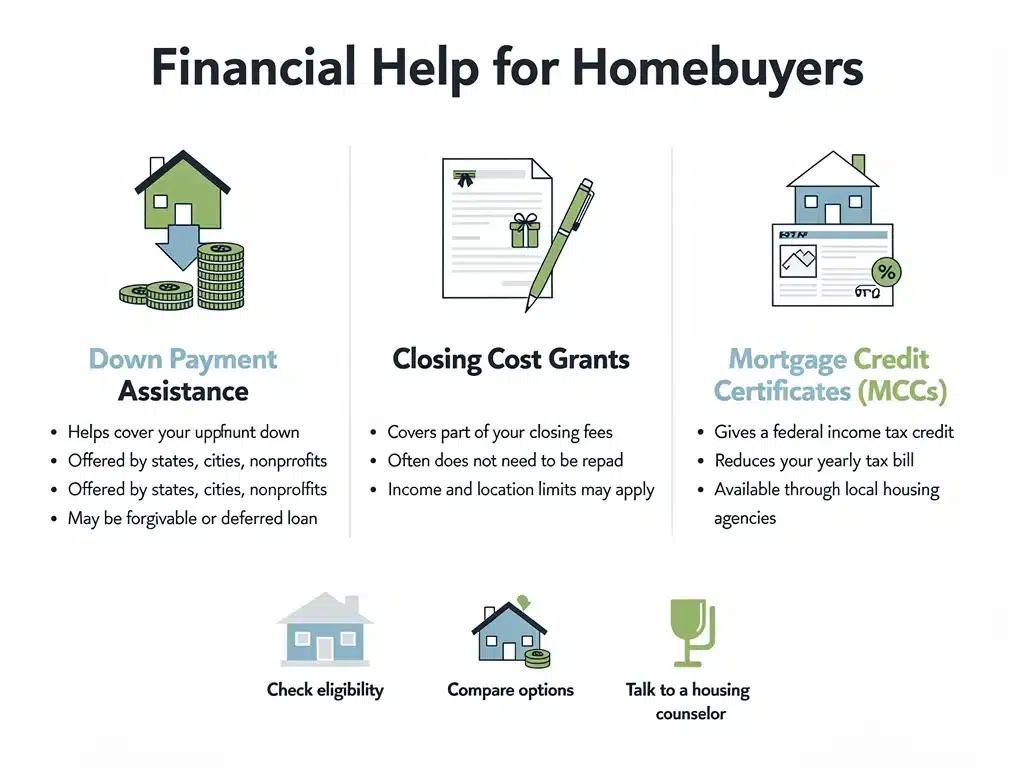
The provision of substantial down payment grants directly translates into tangible financial relief for buyers, potentially reducing the loan-to-value ratio and sometimes even eliminating the need for private mortgage insurance (PMI). This can lead to lower monthly mortgage payments, making homeownership more sustainable in the long run.
From a broader economic perspective, the influx of grant money is expected to stimulate the housing market by increasing demand and facilitating more transactions. This can benefit various sectors, from construction and real estate to retail and local services, contributing to overall economic vitality.
- Reduced upfront costs for homebuyers.
- Potential elimination of private mortgage insurance (PMI).
- Increased purchasing power for eligible individuals.
- Positive ripple effect on local economies and housing markets.
Direct quotes and attributed summaries show positions, responsibilities, and next steps from various stakeholders. Independent experts assess the credibility of the information and likely outcome scenarios, providing a balanced view of the programs’ potential impact.
Future Trends and Regional Variations
The implementation of New Homebuyer Assistance Programs 2026: Accessing Up to $10,000 in Down Payment Grants is not a one-size-fits-all scenario. Future trends indicate a greater emphasis on regional variations, with programs tailored to address specific local housing market conditions and demographic needs.
States and municipalities are expected to develop their own complementary programs, often building upon federal guidelines but adding unique provisions to serve their constituents more effectively. This localized approach ensures that assistance is relevant and impactful where it’s needed most.
Technological advancements are also set to play a crucial role, with digital platforms simplifying the discovery and application process for various assistance options. Data analytics will inform policy adjustments, making programs more responsive to real-time market shifts.
Anticipated Program Evolution
Expect to see an evolution in how these programs are structured, with a potential shift towards performance-based incentives for developers building affordable housing units. This could further increase the supply of homes accessible to grant recipients.
There’s also a growing discussion around incorporating energy-efficient home incentives into assistance programs, encouraging environmentally friendly choices among new homeowners. This aligns with broader sustainability goals and offers long-term savings for residents.
- Increased customization of programs at state and local levels.
- Integration of technology for easier application and management.
- Incentives for developers to build affordable housing.
- Potential inclusion of energy-efficiency incentives for homebuyers.
For now, practical effects are concentrated in specific areas, while broader impacts depend on future decisions and compliance with new guidelines. This highlights the importance of monitoring local announcements and adapting to regional program specifics.
Preparing for New Homebuyer Assistance Programs 2026
Prospective homebuyers should begin preparing now to maximize their chances of benefiting from the New Homebuyer Assistance Programs 2026: Accessing Up to $10,000 in Down Payment Grants. This involves a multi-faceted approach, focusing on financial readiness, education, and active monitoring of program developments.
Improving credit scores, reducing existing debt, and saving consistently are fundamental steps that will enhance eligibility and improve overall financial health. These actions demonstrate responsible financial behavior, which is often a key criterion for grant approval.
Engaging with housing counselors and attending homebuyer education workshops can provide invaluable insights and guidance. These resources can help navigate the complexities of the home-buying process and ensure applicants are well-informed.

Steps to Take Now
Start by reviewing your current financial situation, including income, expenses, and existing debts. Identify areas for improvement, such as paying down high-interest credit card balances or establishing an emergency savings fund. A strong financial foundation is crucial.
Research local housing authorities and non-profit organizations that offer homebuyer education and counseling services. These entities often have early information on upcoming programs and can provide personalized advice tailored to your circumstances.
- Improve credit score and reduce debt.
- Save consistently for a down payment and closing costs.
- Attend homebuyer education workshops.
- Consult with housing counselors for personalized advice.
Staying informed through official government websites, reputable housing news outlets, and local community organizations will be essential. Program details can change, and being up-to-date will ensure you don’t miss critical deadlines or new opportunities.
Navigating the Application and Approval Process
The application and approval process for the New Homebuyer Assistance Programs 2026: Accessing Up to $10,000 in Down Payment Grants, while simplified, still requires meticulous attention to detail. Applicants must ensure all required documentation is accurately completed and submitted within specified timeframes to avoid delays or disqualification.
Working closely with a knowledgeable lender who specializes in government-backed loans and assistance programs can significantly ease this journey. Such lenders are often well-versed in the specific requirements and can guide applicants through each step, from pre-approval to closing.
Be prepared for a review period during which program administrators assess your eligibility and the completeness of your application. Patience and prompt responses to any requests for additional information will be key to a successful outcome.
Tips for a Smooth Application
Before even starting the application, gather all necessary financial documents, including recent pay stubs, tax returns, bank statements, and any existing loan agreements. Having these readily accessible will save considerable time and effort.
Consider obtaining a pre-approval for a mortgage before applying for the grant. This not only demonstrates your seriousness as a buyer but also provides a clear picture of your borrowing capacity, which can be useful when determining the amount of grant assistance you might need.
- Gather all financial documents in advance.
- Seek pre-approval for a mortgage.
- Communicate effectively with your lender and program administrators.
- Double-check all forms for accuracy before submission.
Understanding the typical timeline for application review and approval can help manage expectations. While some programs may offer expedited processing, it’s generally wise to anticipate a few weeks for a thorough assessment of your application.
Long-Term Benefits of Homeownership with Assistance
Beyond the immediate financial relief provided by the New Homebuyer Assistance Programs 2026: Accessing Up to $10,000 in Down Payment Grants, homeownership offers a multitude of long-term benefits. These advantages extend from building personal wealth to fostering community stability and providing a sense of permanence.
Owning a home allows individuals to build equity over time, which can serve as a significant financial asset. This equity can be leveraged for future investments, home improvements, or even as a safety net during unforeseen circumstances, contributing to long-term financial security.
Furthermore, homeownership often leads to greater community engagement and stability. Homeowners tend to invest more in their neighborhoods, participate in local governance, and contribute to the overall well-being of their communities, creating a positive feedback loop.
Building Wealth and Community
For many, a home is their largest asset, and its appreciation can be a powerful engine for wealth creation. The principal portion of each mortgage payment acts as a forced savings mechanism, steadily increasing the homeowner’s net worth. This is a stark contrast to renting, where monthly payments do not contribute to personal equity.
The stability of a fixed-rate mortgage payment can also offer protection against rising rental costs, providing predictable housing expenses for decades. This financial predictability is invaluable for budgeting and long-term financial planning, especially in an unpredictable economic climate.
- Accumulation of home equity over time.
- Protection against rising rental costs with a fixed-rate mortgage.
- Increased personal wealth and financial stability.
- Enhanced community involvement and neighborhood improvement.
The educational components often integrated into these assistance programs also empower homeowners with the knowledge to maintain their properties, make wise financial decisions, and sustain their homeownership for years to come, ensuring the benefits are lasting.
| Key Point | Brief Description |
|---|---|
| Program Focus | Aid for first-time buyers and low-to-moderate income households. |
| Grant Amount | Up to $10,000 for down payments and closing costs. |
| Eligibility | Income limits, credit score, homebuyer education required. |
| Preparation | Improve credit, save, attend workshops, monitor updates. |
Frequently Asked Questions About Homebuyer Assistance
The primary goals are to increase homeownership rates, particularly among first-time and low-to-moderate income buyers, by making housing more affordable. These programs aim to reduce financial barriers like down payments and closing costs, thereby stabilizing communities and stimulating local economies.
Eligible applicants for New Homebuyer Assistance Programs 2026 can expect to access up to $10,000 in down payment grants. The exact amount may vary based on individual program specifics, location, and the applicant’s financial situation, so checking local guidelines is crucial.
General eligibility often includes being a first-time homebuyer, meeting specific income limits based on the area median income, having a satisfactory credit score, and completing a certified homebuyer education course. Some programs may have additional criteria specific to their region or target demographic.
While specific launch dates vary, it is advisable to start preparing now. Many programs operate on a rolling basis or have application windows. Staying updated with official announcements from federal, state, and local housing authorities is the best way to know when applications open.
Most down payment grants under New Homebuyer Assistance Programs 2026 are structured as non-repayable funds, provided certain conditions are met, such as remaining in the home for a specified period. However, some may be structured as deferred loans that are forgiven over time or due upon sale, so always review terms carefully.
Looking Ahead
The emergence of New Homebuyer Assistance Programs 2026: Accessing Up to $10,000 in Down Payment Grants signifies a pivotal moment for the US housing market. It reflects a concerted effort to address affordability challenges and expand access to homeownership. Prospective buyers should view this as a clear call to action, beginning their preparations now to capitalize on these forthcoming opportunities.
Monitoring official announcements, engaging with housing resources, and bolstering personal finances will be key to success. The landscape is set to become more inclusive, offering a tangible pathway to homeownership for a broader segment of the population. This initiative is more than just financial aid; it’s an investment in the future stability of individuals and communities across the nation.
The long-term implications are significant, promising not only individual wealth creation but also a more robust and equitable housing ecosystem. As 2026 approaches, staying informed and proactive will empower aspiring homeowners to turn their dreams into reality with the support of these vital programs.